
AI Agents for Laboratory Instruments: 7 Use Cases and What to Automate First
AI agents for laboratory instruments combine reasoning with access to instrument software, documentation and observations. Useful applications include explaining faults, preparing methods, monitoring runs and coordinating approved experiments. The best first application solves a recurring task whose inputs, permitted actions and outcome your team can check.
For an instrument manufacturer, that choice determines much of the engineering work. An assistant that explains an error needs trustworthy documentation. An agent that submits a measurement also needs execution ownership, current instrument state and a way to establish what happened after submission.
This guide helps instrument product teams and laboratory automation engineers choose a first custom AI agent or assistant. The seven use cases below are proposed designs whose suitability depends on the instrument and workflow.
Key Takeaways
- Start with one recurring instrument task and a measurable acceptance condition.
- Separate access to information, preparation of a candidate workflow and permission to execute it.
- Analytical instruments offer useful starting points in sequence preparation, run monitoring and exception triage.
- MCP can expose tools to an agent; device integration and physical verification remain engineering responsibilities.
- Evaluate AI agents for laboratory instruments against failure cases as well as successful requests. Record whether evidence comes from simulation or hardware.
Why instrument teams are evaluating agents now
Recent work is making the connection between language models and physical equipment more concrete. Anthropic's Model Hardware Standard research preview, announced on August 27, 2026, describes agents working with programmable equipment including liquid handlers, microscopes and robotic arms. These are early demonstrations reported by Anthropic and its collaborators, with limitations in physical reasoning and a continuing need for oversight.
The research extends beyond liquid handling. An August 2026 preprint on atomic-force microscopy describes MCP-connected agents that translate instructions into checked commands, adjust imaging parameters and perform constrained post-processing. The authors report live-instrument experiments; their findings apply to the tested setup and tasks.
Other work addresses the software boundary. A July 2026 study of schema-bound instrument control combines typed tools, physical bounds, persistent jobs and local language models. Its authors explicitly describe software-only validation, so it should not be read as evidence of successful operation on physical instruments.
These developments give product teams concrete approaches to examine. The useful next decision is which customer task deserves an agent capability, and what your team would need to prove before releasing it.
Seven practical use cases for instrument AI agents
The table distinguishes the proposed output from the evidence needed to accept it. Each row can become a bounded project; combining all seven into a first release makes it harder to identify what is working.
| Use case | Useful output | Evidence to require |
|---|---|---|
| Fault explanation | An explanation linked to the correct manual | Source and version match |
| Run monitoring | A status summary with its timestamp | Agreement with instrument events |
| Sequence preparation | A reviewable sample sequence | Correct sample and method identities |
| Protocol preparation | A checked candidate workflow | Constraints and refusals tested |
| Instrument coordination | An ordered handoff between devices | Ownership and completion observed |
| Exception triage | A supported recovery recommendation | Uncertain outcomes kept explicit |
| Experimental optimization | A bounded proposal for the next run | Objective, limits and stop conditions |
1. Explain instrument faults with traceable sources
A scientist sees an unfamiliar error on a chromatograph or plate reader. An assistant retrieves the relevant documentation, explains the recorded condition and identifies the information needed to narrow the diagnosis.
The integration needs the instrument model, software version, error context and access to approved documentation. A manual from a similar instrument is not an adequate substitute. The answer should distinguish what the instrument reported from possible explanations.
Test it against known support cases, outdated manuals and missing context. A useful assistant can say that the evidence is insufficient and direct the operator to the applicable procedure. Measure time to a correct, supported answer and the rate of unsupported recommendations.
2. Monitor runs and explain blocked work
An agent can answer questions such as “Which measurements are still running?” or “Why has this workflow stopped progressing?” by combining status, events and run identity into an explanation.
Each observation needs a timestamp and a known source. If an instrument disconnects, the answer must preserve the distinction between its last reported state and its current, unknown state. Silence from a device cannot establish that it has finished.
Compare summaries with recorded event timelines, including delayed messages and disconnects. Track detection delay and missed exceptions. A conversational interface is useful when it reduces the effort of interpreting a run; a straightforward dashboard may be enough when users only need one status value.
3. Prepare analytical methods and sample sequences for review
For an analytical instrument, a useful first capability can be preparing a sequence around methods that already exist. The agent collects the intended samples, selects an explicitly identified method and produces a candidate sequence for review.
Keep method creation, method selection and sequence submission as separate permissions. Asking to use an existing HPLC method does not authorize inventing a new gradient or changing acquisition settings. The integration should preserve method versions, sample identifiers and any ordering rules defined by the laboratory.
Measure preparation time, corrections required and identity errors against the current workflow. This can deliver a useful authoring capability before the team enables unattended submission or adaptive method development.
4. Translate a protocol into a checked candidate workflow
A scientist describes a liquid-handling task and receives a structured plan that can be inspected before execution. PNNL's AutoLabs work, published in June 2026, illustrates the research direction of translating experimental goals into robot-specific instructions.
The engineering question is how the candidate is checked. Tool schemas can validate argument structure; workflow checks may also need available volume, labware identity, capacity and ordering. A simulator only covers the conditions it models.
At QPillars, LiquidBridge provides a demonstration environment with a simulated liquid-handler backend for exploring this workflow. Simulation supports repeatable software evaluation; it does not establish liquid-transfer accuracy or physical completion. Our guide to workflow dry runs explains the checks and their boundaries.
5. Coordinate a handoff between instruments
Consider a workflow that prepares a plate and then measures it. An agent may help interpret the requested workflow or select an approved sequence, while execution software reserves devices and manages the handoff.
The receiving device needs evidence that the preceding step completed and the required material is available. Shared equipment also needs a single authority for execution ownership. A second agent must not be able to start conflicting work simply because it has access to the same tool.
Test delayed completion, unavailable devices and competing requests. Evaluate successful handoffs and recovery effort against a declared baseline. Existing scheduling and instrument-control software should retain the responsibilities it already performs reliably.
6. Triage exceptions without blindly repeating actions
A command times out after submission. The agent can gather logs, correlate the command with instrument events and explain the available recovery options. Its most valuable result may be identifying what remains unknown.
A missing acknowledgement does not prove that a physical action failed. Repeating an injection or dispense could consume material twice. Recovery therefore needs command identity, authoritative observations and an explicit rule for when an operator must inspect the instrument.
Evaluate whether the system distinguishes rejected, running, completed and uncertain operations. Read-only triage can be a useful starting scope; automated recovery requires separate acceptance evidence. The instrument contract guide examines this execution boundary in more detail.
7. Propose the next experiment within explicit limits
In a bounded research workflow, an agent can interpret a result and propose a next setting or experiment. This requires a defined objective, an allowed action space and a stopping rule, alongside trustworthy measurement data.
Separate the reasoning method from the execution authority. A numerical optimizer may be better suited to selecting parameters for a well-defined objective, while an agent helps explain results or prepare the next candidate. Neither should bypass the instrument's operating limits.
Evaluate the proposed approach against a specified baseline and report failed trials as well as improvements. The cited microscopy research offers one example to study, not a general guarantee that autonomous optimization will transfer to a different instrument or assay.
Choose the first capability by its execution boundary
There are three useful starting scopes: observing a workflow, preparing a candidate and executing an authorized action. They require different evidence. A product can remain valuable at any of these scopes; extending execution authority is a separate product decision.
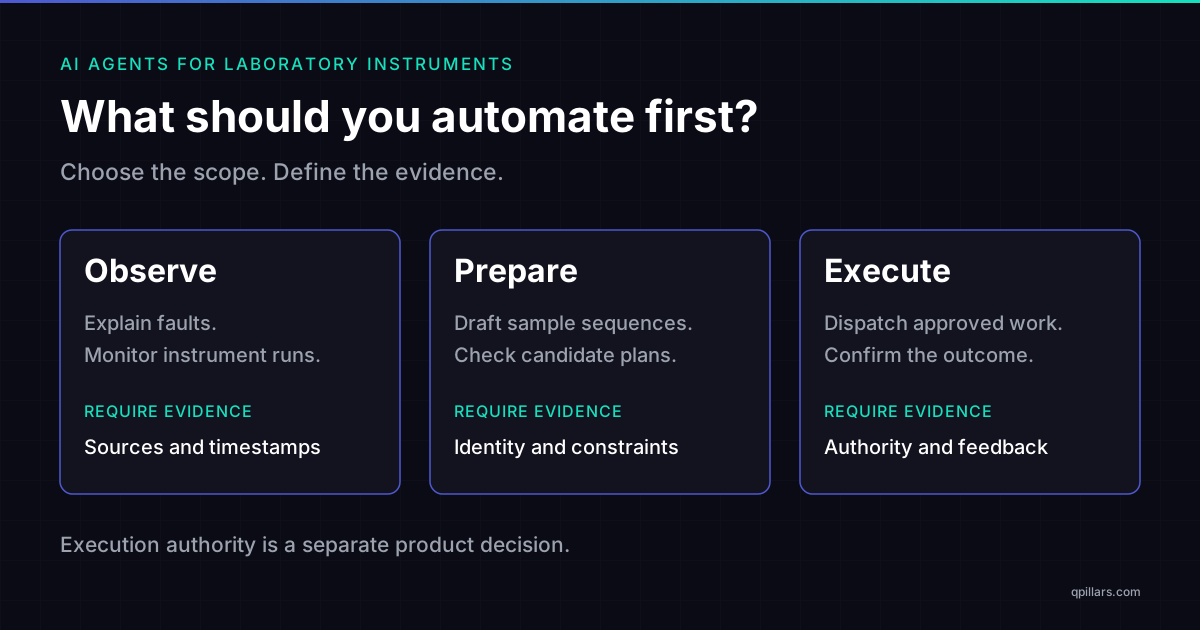
The diagram separates three scopes and their evidence: observe means explaining faults or monitoring runs using sources and timestamps; prepare means drafting sequences or checking plans against identities and constraints; execute means dispatching approved work and confirming its outcome through authoritative feedback. Reading data still requires access controls and careful handling of sensitive information. Physical execution adds responsibility for authorization, interlocks and observed completion.
Use four questions to select a first workflow:
- Does the task recur? Identify who performs it, how often it occurs and what currently takes their time.
- Can the required information be accessed? Establish the actual API, SDK, files, documentation or telemetry available, including licensing and deployment constraints.
- Can the permitted effects be bounded? Define which operations the system may propose, which it may perform and who owns approval.
- Can success and failure be observed? Specify what evidence distinguishes a correct result from a plausible answer.
Choose a workflow with a clear answer to all four. If the current pain is interpreting faults, begin there. If sequence preparation consumes hours but execution already works well, build around that authoring step.
Worked example: an HPLC sequence assistant
The following is an illustrative design exercise, not a deployed QPillars HPLC integration or a validated analytical method.
Suppose an operator asks: “Prepare a sequence for these sample IDs using our approved assay method. Show me the sequence before submission.” The useful output is a reviewable candidate that preserves the laboratory's existing method and sample requirements.
| Stage | Required behavior |
|---|---|
| Resolve the request | Identify the exact sample list and method version; ask about missing information |
| Prepare the candidate | Apply the laboratory's existing sequence rules without inventing parameters |
| Check the candidate | Verify identifiers, required entries and supported values against authoritative records |
| Present for review | Show the proposed sequence, source records and unresolved questions |
| Submit if authorized | Bind approval to that candidate and recheck relevant state before submission |
| Observe the outcome | Track the submitted sequence using the instrument software's execution record |
Now introduce a failure: the user supplies a method name that matches two versions. The correct result is an unresolved selection requiring clarification. Picking the most recent file silently would turn an authoring convenience into an undocumented method change.
Introduce a second failure: the connection drops after submission. The interface should report that the submission outcome is uncertain until it can reconcile against the instrument's record. It should not automatically submit another copy.
These cases make acceptance concrete. Compare candidate sequences with expert-reviewed expected outputs, include ambiguous requests and submission failures, and measure correction time. If the interface cannot reveal submission identity or execution state, keep the first capability at preparation and export.
Where MCP, SiLA 2 and MHS fit
Your first workflow determines which integration capabilities you need. An instrument may already expose sufficient functionality through its vendor SDK or API; preserve that investment while making the agent-facing behavior explicit.
MCP's tool specification defines discovery and invocation of named tools with schemas. It gives the agent a consistent interface to software capabilities. It does not replace the engineering needed to interpret a device's state or confirm a physical outcome.
SiLA 2 provides laboratory device communication through Features, Commands and Properties, including observable execution concepts. An adapter can expose selected capabilities to an agent while retaining the underlying device contract. The mapping still needs to preserve units, errors and lifecycle information.
MHS is an emerging hardware abstraction described in Anthropic's research preview. Teams can investigate it while continuing to improve the interfaces, observations and controls required by their chosen workflow. Our MHS, MCP and SiLA 2 comparison covers their distinct responsibilities; the MCP connection guide covers implementation patterns.
Deployment also matters. Determine where the agent runs, which data may leave the laboratory network and which system grants access. The availability of local models is an architectural option, not evidence that a particular model meets your accuracy or latency requirements.
What a useful first pilot should demonstrate
A small workflow check from LiquidBridge
On September 13, 2026, we replayed a supplied transfer candidate through LiquidBridge's workflow validator at revision 8ff76e2. The candidate represented “Transfer two samples using 20 µL.” We supplied the structured candidate directly; this check did not test a language model's interpretation of the request.
| Checkpoint | Tip rack absent | Tip rack present |
|---|---|---|
| Supplied candidate | Transfer two samples, 20 µL each | Same candidate |
| Fixture change | No tip rack on the deck | Tip rack with available tips |
| Observed check result | Rejected during action expansion: no tip rack | Expanded into 16 backend validation requests |
| Backend validation requests | Zero | 16, all accepted by a recording stub |
| Approval and execution | Not exercised | Not exercised |
This was a software check with synthetic deck state and a backend stub that returned valid responses. It demonstrates that an absent tip rack prevents this candidate from reaching backend validation. The accepted case demonstrates expansion and request routing; it does not establish backend correctness, approval enforcement or physical transfer performance.
That distinction is useful when defining a pilot. One observable refusal is evidence for one boundary. End-to-end acceptance still needs the real planning, approval and execution path, with the relevant hardware observations.
Define the acceptance evidence
Write the acceptance conditions before building the interface. Record the workflow, responsible user, baseline and permitted actions, then select representative requests and failures.
A useful evidence packet includes:
- Correct outputs on a declared set of ordinary tasks, with time and correction effort compared against the existing process.
- Expected behavior when information is missing, conflicting or out of date.
- Refusal of unauthorized or unsupported actions, including attempts to bypass approval.
- Recovery behavior for disconnects and ambiguous completion if execution is in scope.
- Traceability from request to candidate, checks, authorization and observed result.
- The tested software and model versions, with simulation and hardware results identified separately.
Repeat representative evaluations when a model or tool interface changes. Keep the claims proportional to the evidence: a passing software test demonstrates that tested behavior, not the suitability of the entire system for every laboratory context. Our reliable instrument-agent guide develops this evaluation approach.
Frequently Asked Questions
Can AI agents work with existing laboratory instruments?
Often, an integration can use an existing SDK, API or supported export interface. The available capabilities determine the scope: access to files may support interpretation, while run submission requires a control interface and an observable execution lifecycle. Confirm support for the specific instrument and software version before promising a workflow.
What is a useful first AI application for analytical instruments?
Fault explanation, run monitoring and sequence preparation are candidates when they solve a recurring user problem. Choose the task for which you have authoritative inputs and can measure output quality. Autonomous parameter changes require additional evidence and permission boundaries.
Do AI agents for laboratory instruments need MCP?
MCP is one way to expose tools consistently to an agent. A bounded integration can also use other supported software interfaces. The essential work is defining permitted actions, preserving instrument semantics and observing outcomes, whichever interface is used.
Does a successful dry run prove that a workflow will succeed on hardware?
No. A dry run can check the conditions represented by its model and the state supplied to it. Physical performance, unmodeled conditions and state changes before execution require additional observations and validation.
How should an instrument manufacturer start?
Choose one instrument, one recurring task and one acceptance condition. Confirm access to the required information, keep execution authority explicit and evaluate against real examples of success and failure. Expand the scope only when the evidence supports the next capability.
Discuss one instrument workflow
QPillars builds custom AI agents and assistants for laboratory and analytical instruments. We help instrument teams turn a recurring user task into an evaluated capability, with the integrations and execution controls it needs to work with existing equipment.
Discuss one instrument workflow with QPillars. Bring the instrument, its available interface and the task your users want to improve.
Technical Lead & Co-founder at QPillars
Specializes in laboratory automation, from hands-on instrument control and liquid handling to AI-driven protocol orchestration.