
Laboratory Automation Software Comparison 2026 - LIMS, ELN, and the Rise of API-First Platforms
Laboratory Automation Software Comparison 2026 - LIMS, ELN, and the Rise of API-First Platforms
The laboratory automation software market reached an estimated $2.9 billion in 2025 and is projected to exceed $5 billion by 2030, growing at a CAGR of 12.5% (MarketsandMarkets, 2025). The broader lab automation market - hardware, robotics, and software combined - sits at $8.9 billion and is accelerating toward $24 billion by 2035 (SNS Insider, 2026). Yet most labs are still choosing between platforms designed in the 2000s and platforms built for what labs actually need in 2026.
This post compares the major categories of laboratory automation software, evaluates the dominant vendors, and provides a decision framework for labs evaluating their options - particularly those that want AI-native workflows, not AI as an afterthought.
Key Takeaways
- LIMS, ELN, and custom platforms solve different problems - most labs need elements of all three, and the real question is whether they come integrated or stitched together
- Legacy LIMS architectures (client-server, on-premises, proprietary middleware) are fundamentally incompatible with AI-native workflows that require real-time data access and tool composition
- API-first platforms like Benchling represent the current best practice, but still require custom integration for each instrument and data source
- MCP-native architecture is the emerging standard - a single protocol that lets AI agents discover and use lab instruments, LIMS, and data sources without custom connectors
- No single vendor covers everything well - the decision framework matters more than the vendor comparison
Three Categories of Lab Software - and Why the Lines Are Blurring
Before comparing vendors, it helps to understand what you are actually comparing. The three dominant categories of laboratory automation software - LIMS, ELN, and custom platforms - were designed for different eras and different problems.
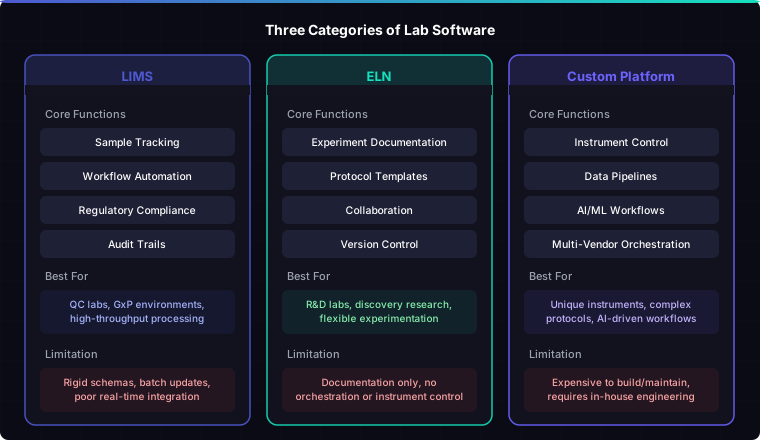
The diagram above shows how these three categories overlap in practice. Most modern labs need sample tracking (LIMS), experiment documentation (ELN), and instrument integration (custom) - and the vendors are racing to cover all three from their respective starting points.
LIMS - Laboratory Information Management System
A LIMS manages samples, workflows, and regulatory compliance. It tracks where every sample is, what happened to it, and whether the process followed SOPs. The core value proposition is traceability and audit trails.
Best for: QC labs, regulated environments (GxP, ISO 17025), high-throughput sample processing
Limitations: Most LIMS were designed as databases with workflow engines bolted on. They excel at structured, repetitive processes but struggle with exploratory research, ad-hoc queries, and real-time instrument integration. The data model is typically rigid - adding a new sample type or workflow requires configuration by a specialist, not a scientist.
ELN - Electronic Lab Notebook
An ELN replaces the paper lab notebook. It captures experimental design, observations, raw data, and conclusions in a searchable, auditable format. Modern ELNs add collaboration, version control, and protocol templates.
Best for: R&D labs, discovery research, any environment where experimental flexibility matters more than rigid sample tracking
Limitations: ELNs are documentation tools, not orchestration tools. They record what happened but do not drive what happens next. Integration with instruments is typically manual - a scientist exports data from the instrument software and attaches it to a notebook entry.
Custom Platforms and Middleware
When LIMS and ELN do not cover a lab's needs - particularly around instrument control, data pipelines, and AI/ML workflows - labs build custom solutions. These range from Python scripts connecting instruments to databases, to full middleware platforms that orchestrate multi-instrument workflows.
Best for: Labs with unique instruments, complex multi-step protocols, or AI-driven workflows that no off-the-shelf platform supports
Limitations: Custom platforms are expensive to build and maintain. They require in-house software engineering talent, which most labs lack. They also create vendor lock-in to your own team - if the engineer who built it leaves, the platform becomes a liability.
Vendor Comparison - Architecture, AI Readiness, and Integration
Here is how the major players stack up across the dimensions that actually matter for labs planning their software infrastructure in 2026.
| Capability | Benchling | LabWare | STARLIMS | Thermo Fisher SampleManager |
|---|---|---|---|---|
| Architecture | Cloud-native, multi-tenant SaaS | Client-server, on-prem or hosted | Client-server (.NET), on-prem or cloud | .NET framework, on-prem/AWS/hybrid |
| API quality | REST API, well-documented, events system, data warehouse | SOAP/REST, requires specialist configuration | REST API, improving but limited documentation | REST API with token auth, SAP integration |
| Primary strength | Biotech R&D, molecular biology, sequence design | Enterprise LIMS, extreme configurability | Regulated environments, compliance, forensics | QC labs, chromatography integration, analytics |
| AI readiness | Benchling AI (3 agents, Bayesian ML, AlphaFold access) | Minimal - architecture predates AI patterns | Analytics 2.0 with some AI features, bolt-on | ATR (Autonomous Test Revisor), BI dashboards |
| Instrument integration | Via API - each instrument needs custom connector | Vendor middleware, proprietary protocols | Vendor-specific connectors, middleware | Chromeleon CDS link, proprietary connectors |
| Deployment | Cloud only (SaaS) | On-premises primary, cloud optional | On-premises primary, cloud optional | On-prem, AWS hosted, or customer cloud |
| Pricing model | Per-user SaaS, costs escalate with scale | Enterprise licensing + implementation | Enterprise licensing + consulting | Enterprise licensing + modules |
| Implementation time | Weeks to months | Months to years | Months to years (extensive consulting) | Months to years |
| Sweet spot | Series B+ biotech, genomics, molecular biology | Large enterprise labs, multi-site QC | Government, forensics, pharma compliance | Pharma QC, environmental testing |
Benchling - The Cloud-Native Contender
Benchling is the closest thing to a modern software product in the LIMS/ELN space. Built cloud-native from day one, it combines ELN, LIMS, and molecular biology tools (plasmid editor, CRISPR design) in a unified platform with a clean UI that scientists actually want to use.
What works: The API is genuinely well-documented and designed for integration. Events and webhooks enable real-time data flows. The data warehouse feature lets you query across all your experimental data. In October 2025, Benchling launched Benchling AI with three embedded agents (Deep Research, Compose, Data Entry), Bayesian experiment optimization, and access to protein structure models like AlphaFold. This makes Benchling the only major platform with native AI agents in the scientist workflow.
What does not: Benchling is expensive at scale - pricing escalates as organizations grow, and the per-user model hits hard when you need to give access to collaborators, manufacturing teams, or QC. It is also biotech-centric - chemistry, materials science, and environmental testing labs will find gaps. While Benchling AI is a genuine leap, the agents are focused on research tasks (literature review, data entry, experiment design) - not on instrument orchestration or multi-system workflow composition. For labs that need AI agents to drive physical instruments, Benchling's AI is necessary but not sufficient.
LabWare - The Enterprise Workhorse
LabWare has been a dominant LIMS for decades. Its strength is extreme configurability - you can model virtually any laboratory workflow, sample type, or business rule. It has the largest installed base globally and supports multi-site, multi-language deployments.
What works: If your requirement is "configure any workflow without writing code," LabWare delivers. The platform is battle-tested in the most demanding regulatory environments. Its global support network is extensive.
What does not: Implementation is notoriously complex. Almost every user reports a steep learning curve and substantial IT resources required. The architecture is fundamentally client-server and on-premises-first, which means real-time AI integration requires significant middleware. The API layer (historically SOAP-based, with REST added later) reflects its age. Getting data out of LabWare and into an AI pipeline is possible but never simple.
STARLIMS (Abbott) - The Compliance Specialist
STARLIMS, now owned by Abbott Informatics, is built for labs where compliance is not a feature but the entire point. Government labs, forensics, pharma manufacturing - environments where audit trails, chain of custody, and validated workflows are non-negotiable.
What works: Regulatory compliance out of the box. Mobile-friendly features. The recent Advanced Analytics 2.0 release shows genuine modernization effort, including AI-powered anomaly detection and predictive analytics.
What does not: The core platform still demands significant technical expertise. Implementation typically requires extensive consulting services, substantially increasing total cost of ownership. The interface, while improving, feels dated compared to cloud-native alternatives. Integration with external systems remains connector-dependent rather than API-first.
Thermo Fisher SampleManager - The Analytical Lab Standard
SampleManager is deeply embedded in pharmaceutical QC and environmental testing labs. Its tight integration with Thermo's chromatography ecosystem (Chromeleon CDS) makes it the natural choice for labs that are already running Thermo instruments.
What works: The Chromeleon link eliminates manual data transfer between chromatography systems and LIMS. The Autonomous Test Revisor (ATR) is one of the few genuinely useful AI features shipping in a production LIMS - it automates routine data review. REST API with modern token authentication. Multiple deployment options including AWS hosted.
What does not: You are buying into the Thermo ecosystem. If your lab runs instruments from multiple vendors, SampleManager's integration advantage narrows. The .NET architecture, while reliable, is not built for the kind of real-time, event-driven AI workflows that modern agent architectures require.
Integration Approaches - The Real Differentiator
The vendor comparison above matters less than you might think. The real question is not "which LIMS?" but "how does your software talk to everything else?" This is where laboratory automation software approaches diverge most dramatically.
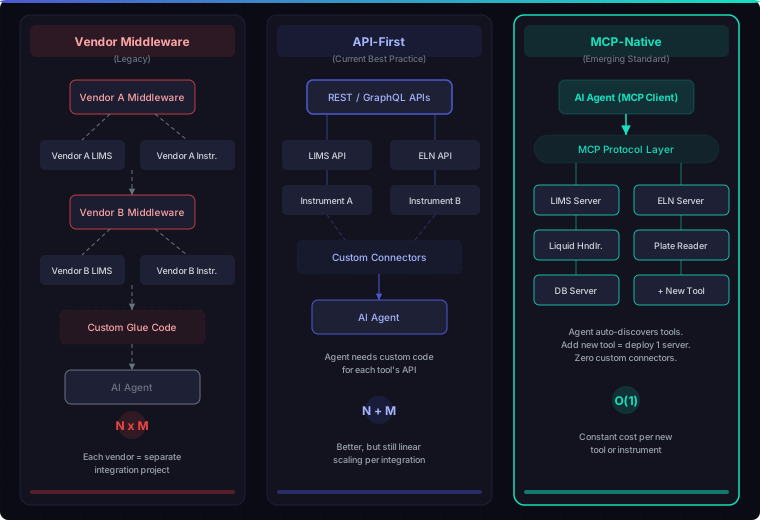
The diagram above contrasts the three integration architectures. Vendor middleware creates a hub-and-spoke pattern with proprietary connectors. API-first uses REST/GraphQL but requires point-to-point integration for each pair of systems. MCP-native provides a universal protocol where any AI agent can discover and use any MCP-enabled tool.
Vendor Middleware (Legacy)
Traditional laboratory automation relies on vendor-provided middleware to connect instruments to LIMS. Hamilton VENUS talks to Hamilton liquid handlers. Beckman SAMI orchestrates Beckman systems. Thermo SampleManager links to Thermo Chromeleon. Each vendor provides a vertical stack - instrument, control software, and middleware - that works well within its own ecosystem and poorly with everything else.
The problem: A typical lab runs instruments from 5-10 vendors. Each vendor's middleware speaks a different language. Connecting them requires custom "glue code," integration specialists, and months of validation. Adding a new instrument to an automated workflow means a new integration project, not a configuration change. And AI agents cannot reason about instruments they cannot access through a common interface.
API-First (Current Best Practice)
Platforms like Benchling represent the API-first approach - expose everything through well-documented REST APIs, and let integrators build what they need. This is a genuine improvement. An external system can query samples, update results, trigger workflows, and subscribe to events through a standard HTTP interface.
The limitation: API-first still requires point-to-point integration. Connecting Benchling to a plate reader requires writing code that knows both the Benchling API and the plate reader's API. Connecting it to a liquid handler is a separate project. Each integration is bespoke. For AI workflows, this means the AI agent needs custom code for every tool it can use - every instrument, every database, every service. This scales linearly with the number of tools, which is exactly the wrong scaling curve.
MCP-Native (Emerging Standard)
The Model Context Protocol (MCP) inverts the integration model. Instead of building custom connectors from every system to every other system, each system exposes its capabilities through a standard protocol. An AI agent does not need to know the Benchling API, the plate reader API, and the liquid handler API separately. It discovers what tools are available through MCP, understands their capabilities from standardized descriptions, and uses them through a uniform interface.
MCP has reached 97 million monthly SDK downloads with over 6,400 servers on official registries (Pento, 2025). In December 2025, Anthropic donated MCP to the Agentic AI Foundation under the Linux Foundation, with co-founding members including OpenAI, Google, Microsoft, and AWS (Anthropic, 2025). It has moved from experimental to production-grade, with the November 2025 specification adding enterprise features like OAuth 2.1 authentication, server identity, and streaming.
Why this matters for labs: A lab with MCP-native infrastructure can add a new instrument by deploying one MCP server for that instrument. Every AI agent in the lab immediately gains access to it - no custom integration, no middleware, no vendor lock-in. The same agent that manages your liquid handler can query your LIMS, check your ELN, and trigger an analysis pipeline - all through MCP.
The catch: MCP-native laboratory infrastructure is still early. Most instrument vendors do not ship MCP servers (yet). Labs building this today are writing their own MCP servers on top of vendor APIs - which requires engineering talent. But the trajectory is clear, and labs that build MCP-native now will have a structural advantage as the ecosystem matures.
Where Legacy Approaches Break Down for AI
The core argument for modernizing lab software is not about user interfaces or cloud deployment - it is about AI readiness. Agentic AI for laboratory workflows requires fundamentally different infrastructure than traditional automation.
Here is where legacy approaches fail:
Real-time data access. AI agents need to observe instrument state, sample status, and environmental conditions in real time. Legacy LIMS operate on batch updates - data enters the system after a run completes, not during. An AI agent cannot adapt a protocol mid-run if it cannot see what is happening.
Tool composition. An AI agent orchestrating a multi-step assay needs to chain actions across instruments, databases, and analysis tools. Vendor middleware treats each instrument as an isolated workflow. API-first platforms require the agent to know each API individually. Only MCP-native architecture lets agents compose tools dynamically.
Schema flexibility. AI workflows generate structured data that does not fit neatly into predefined LIMS schemas. Embedding vectors, model predictions, confidence scores, experimental metadata - these need to flow alongside traditional sample data. Rigid LIMS schemas require schema changes (and revalidation) for every new data type. Flexible platforms handle this natively.
Iterative experimentation. Digital twins and AI-driven protocol optimization require running thousands of virtual experiments and feeding results back into the next iteration. Legacy platforms are designed for document-and-forget workflows, not rapid iteration loops.
Decision Framework - Choosing Your Lab Software Stack
Rather than recommending a single vendor, here is a framework for evaluating your options based on what actually matters for your lab.
Step 1 - Classify Your Lab Type
| Lab Type | Primary Need | Recommended Foundation |
|---|---|---|
| Pharma QC / Manufacturing | Compliance, audit trails, validated workflows | Enterprise LIMS (LabWare, STARLIMS, SampleManager) |
| Biotech R&D | Flexibility, collaboration, molecular biology tools | Cloud-native ELN+LIMS (Benchling) |
| High-throughput Screening | Instrument orchestration, data pipelines | Custom platform + LIMS integration |
| Multi-vendor Automated Lab | Cross-vendor instrument control, AI workflows | API-first or MCP-native architecture |
| AI-Native Lab | Agent-driven protocols, digital twins, adaptive workflows | MCP-native platform + lightweight LIMS |
Step 2 - Score Your Integration Requirements
Ask these five questions. Each "yes" pushes you further toward API-first or MCP-native architecture:
- Do you run instruments from three or more vendors?
- Do you need AI agents to orchestrate multi-instrument workflows?
- Do you need real-time data access during runs, not just batch results?
- Are you building or planning to build digital twin capabilities?
- Do you expect to add new instruments or capabilities quarterly, not annually?
0-1 yes: Traditional LIMS with vendor middleware is adequate. Focus on compliance and usability.
2-3 yes: API-first platform is the minimum. Ensure your LIMS has well-documented REST APIs and webhook/event support.
4-5 yes: MCP-native architecture should be your target. You may still need a LIMS for compliance, but it should be a component in an MCP-native stack, not the center of your architecture.
Step 3 - Evaluate Total Cost of Ownership
The sticker price of lab software is misleading. The real costs are:
- Implementation: Enterprise LIMS implementations typically take 6-18 months and cost 2-5x the license fee in consulting. Cloud-native platforms deploy in weeks.
- Integration: Each custom integration costs $50-200K and takes 2-6 months. Count how many you need. MCP-native architecture reduces this to deploying standardized MCP servers.
- Maintenance: On-premises systems require IT infrastructure, upgrades, and security patches. SaaS platforms handle this, but you pay a premium and lose control.
- Opportunity cost: The months spent on implementation and integration are months you are not running AI-driven experiments. For biotech startups, this can be existential.
The Path Forward
The laboratory automation software landscape in 2026 is in a transition period. The legacy vendors (LabWare, STARLIMS, SampleManager) are not going away - they are deeply embedded in regulated environments where stability and compliance matter more than innovation speed. But they are increasingly being complemented, and in some cases replaced, by API-first and MCP-native architectures that enable the AI-driven workflows that modern labs need.
The smartest labs are not ripping out their LIMS. They are wrapping it in an MCP server that exposes its capabilities to AI agents, while building new capabilities on modern, composable infrastructure. This is not a revolution - it is an incremental migration that preserves existing investment while unlocking new possibilities.
The question is not whether your lab will adopt AI-native software infrastructure. It is whether you will build it deliberately now or be forced to retrofit it later - at higher cost and lower quality.
Frequently Asked Questions
Should I replace my LIMS with an ELN or vice versa?
No. LIMS and ELN solve different problems and most labs need both. LIMS handles sample tracking, workflow automation, and regulatory compliance. ELN handles experimental documentation and collaboration. The real question is whether you buy them as an integrated platform (like Benchling, which combines both) or as separate systems that you integrate. Integrated platforms reduce integration burden but may compromise on depth in one area. Separate best-of-breed systems give you more capability but require more integration work.
How do I add AI capabilities to a legacy LIMS?
The most practical approach is to expose your LIMS data through an API layer (most modern LIMS have REST APIs) and build AI workflows that read from and write to the LIMS through that API. For more sophisticated AI agent workflows, wrap your LIMS in an MCP server - this lets any MCP-compatible AI agent interact with your LIMS data without custom code. You do not need to replace your LIMS to use AI. You need to make your LIMS accessible to AI agents.
What is MCP and why does it matter for laboratory software?
MCP (Model Context Protocol) is an open standard for connecting AI agents to external tools and data sources. It matters for labs because it solves the N-times-M integration problem - instead of building custom connectors between every AI agent and every instrument, each instrument exposes an MCP server and every agent speaks MCP. Adding a new instrument means deploying one MCP server, not updating every workflow. See our detailed guide to MCP for lab automation.
Is Benchling worth the cost for smaller biotech companies?
Benchling's per-user pricing model makes it accessible for small teams (under 20 users) but costs escalate significantly as organizations grow. For Series A-B biotechs focused on molecular biology and genomics, Benchling often provides the fastest path to a modern lab software stack. For labs focused on chemistry, environmental testing, or manufacturing QC, the biotech-centric feature set may not justify the premium. Evaluate alternatives like Scispot or Labguru for smaller teams with different focus areas.
How long does a LIMS implementation typically take?
Cloud-native platforms like Benchling can be operational in weeks to a few months. Enterprise LIMS like LabWare, STARLIMS, or SampleManager typically take 6-18 months for full implementation, including workflow configuration, data migration, validation, and training. The implementation timeline is driven primarily by regulatory requirements and workflow complexity, not by the software itself. Budget 2-5x the license cost for implementation consulting with enterprise systems.
Written by Iacob Marian, Technical Lead & Co-founder at QPillars. Published 2026-04-06.
Technical Lead & Co-founder at QPillars
Specializes in laboratory automation, from hands-on instrument control and liquid handling to AI-driven protocol orchestration.