
Self-Driving Labs in 2026 - What Actually Works vs. What's Still Hype
Self-Driving Labs in 2026 - What Actually Works vs. What's Still Hype
Every lab automation vendor now claims to offer a "self-driving laboratory." The term has become so diluted that it covers everything from a Bayesian optimization loop on a single reactor to a fully autonomous robotic facility running 50 instruments without human intervention. Nature's March 2026 feature "Inside the 'self-driving' lab revolution" profiled Alan Aspuru-Guzik's fleet of 50 autonomous robots at the Acceleration Consortium - funded by Can$200M, the largest federal research grant ever awarded to a Canadian university. Meanwhile, Ginkgo Bioworks launched its Cloud Lab, Automata raised $45M to build "the operating system for AI-ready labs," and Chemspeed partnered with SciY to ship a vendor-agnostic SDL platform. The money and the announcements are real. But what actually works?
This post separates signal from noise. We examine what self-driving lab technology is shipping in production, what remains research-only, and why the gap between scripted automation and genuine autonomy is almost entirely a software problem - not a hardware one.
For a practical first step around your existing equipment, compare AI assistants, fixed workflows and AI agents for lab instruments. The guide works through one transfer request and connects the engineering decisions to our hands-on workshops.
Key Takeaways
- Most "self-driving labs" today are Level 2-3 on a five-level autonomy scale - closed-loop optimization on narrow tasks, not general-purpose autonomy
- The hardware is not the bottleneck - robots and instruments are capable enough; the missing piece is the software middleware that connects them into an intelligent system
- Three vendor-agnostic SDL platforms shipped in early 2026 - Chemspeed/SciY, Automata LINQ, and Ginkgo Cloud Lab - each tackling different layers of the stack
- GxP compliance is solvable but constraining - the FDA/EMA joint Guiding Principles of Good AI Practice in Drug Development (January 2026) provide a framework, but autonomous decisions in regulated environments still require human approval
- MCP and SiLA2 are complementary standards that will define how instruments communicate in SDL architectures - MCP for AI agent access, SiLA2 for structured instrument control
- Labs that invest in the software layer now - instrument APIs, data pipelines, digital twins - will have a structural advantage as SDL platforms mature through 2027
The Autonomy Scale - Where SDLs Actually Stand
The self-driving car analogy is useful here. Just as SAE defined levels 0-5 for vehicle autonomy, researchers have proposed an equivalent scale for laboratory automation (Royal Society Open Science, 2025):
| Level | Description | Human Role | 2026 Status |
|---|---|---|---|
| 0 | All manual | Everything | Still common |
| 1 | Repetitive tasks automated | Operator + decision maker | Standard automation |
| 2 | Digital protocols, machine-interpretable data | Supervisor + exception handler | Most "SDLs" are here |
| 3 | Closed-loop DBTL cycles, anomalies flagged | Goal setter + anomaly resolver | Leading SDLs |
| 4 | Full robotic execution + routine analysis | Goal setter only | Demonstrated for narrow tasks |
| 5 | Fully autonomous | None | Does not exist |
The honest assessment: the vast majority of systems marketed as "self-driving labs" operate at Level 2, with a handful reaching Level 3. Level 4 has been demonstrated for robotically simple chemistry tasks in well-defined parameter spaces. Level 5 remains a research aspiration, not an engineering reality.
This is not a criticism - Level 2-3 systems deliver genuine value. Bayesian optimization loops on automated reactors can explore chemical spaces 10-100x faster than manual experimentation. But calling a closed-loop optimization on a single instrument a "self-driving lab" is like calling adaptive cruise control "self-driving."
What Is Actually Shipping in 2026
Three major platform announcements in early 2026 represent genuine progress, each addressing different parts of the SDL stack.
Chemspeed + SciY - The Vendor-Agnostic Stack
Announced at SLAS2026 in February, the Chemspeed/SciY partnership delivers what many labs have been asking for: an open, vendor-agnostic SDL platform that integrates automation, analytics, and AI orchestration without locking you into one vendor's ecosystem.
The platform rests on three pillars:
- Chemspeed's automation - modular, vendor-agnostic instrument control with deterministic execution
- Bruker analytics - NMR, IR/Raman, MS, and X-ray with traceable quantitative data (Chemspeed is a Bruker subsidiary)
- SciY's data backbone - FAIR data capture, ontology-driven semantics, and workflow orchestration
The key differentiator is the open data backbone. SciY provides vendor-agnostic data integration with semantic annotation - meaning data from any instrument gets normalized into a queryable, AI-ready format. This is the middleware layer that most SDL implementations lack.
What this means: For labs that already run Chemspeed automation, this is the most production-ready path to a genuine SDL workflow. The "readily deployable full stack" framing is credible because Chemspeed already controls the physical automation layer.
Automata LINQ - The Orchestration Layer
Automata's $45M Series C (January 2026, led by Dimension with strategic investment from Danaher Ventures) positions their LINQ platform as the orchestration layer for multi-vendor labs. LINQ is a cloud-native engine that lets labs standardize and automate multi-step experimental processes across instruments from different vendors.
The Danaher investment is strategically significant. Danaher owns Beckman Coulter Life Sciences, and the simultaneous partnership announcement integrates Beckman's liquid handling, genomic, and cell analysis instruments directly into LINQ. With five top-pharma companies already as customers and Danaher's Murali Venkatesan on the board, Automata has a clear path to enterprise adoption.
What this means: LINQ addresses the orchestration gap - connecting instruments from different vendors into coordinated workflows. It is not a full SDL (no AI decision engine), but it solves the practical problem of multi-vendor instrument coordination that blocks most labs from even attempting autonomous workflows.
Ginkgo Cloud Lab - The Full Stack (For Biologics)
Ginkgo Bioworks launched Cloud Lab in March 2026 - a web-accessible interface to their autonomous lab infrastructure in Boston. This is the most ambitious SDL deployment currently operational:
- 70+ instruments spanning sample prep, liquid handling, analytical readouts, storage, and incubation
- Reconfigurable Automation Carts (RACs) - modular units with robotic arms, maglev sample transport, and industrial-grade software
- EstiMate - an AI agent that accepts protocols in natural language and returns compatibility assessments
- Targeting 100+ RACs by end of 2026, with all R&D moving onto the autonomous Nebula platform
Ginkgo also demonstrated a collaboration with OpenAI where an AI system autonomously designed, executed, and learned from biological experiments, achieving a 40% cost reduction in cell-free protein synthesis ($422/g vs. the previous state-of-the-art $698/g).
What this means: Ginkgo Cloud Lab is the closest thing to a Level 3-4 SDL in production. But it is purpose-built for synthetic biology, massively capital-intensive, and operates as a service - you cannot buy the platform and run it in your own lab.
The Democratization Play - RoboChem-Flex
On the other end of the spectrum, RoboChem-Flex (published in Nature Synthesis, 2026) shows that SDLs do not require millions in infrastructure. This open-source, modular platform costs approximately $5,000, runs on Python with Bayesian optimization and transfer learning, and has been validated across six chemistry use cases. All code and 3D printing files are on GitHub.
What this means: The SDL concept is no longer gated by hardware cost. A graduate student can set up a closed-loop optimization system for photocatalysis or cross-coupling reactions on a budget. The barrier has shifted entirely to software capability and integration.
The Software Gap - Why Middleware Is the Real Bottleneck
If the hardware is capable and affordable, why are most labs stuck at Level 2? Because a self-driving lab is not an automated lab with an AI model bolted on top. It is a software system that happens to control physical instruments.
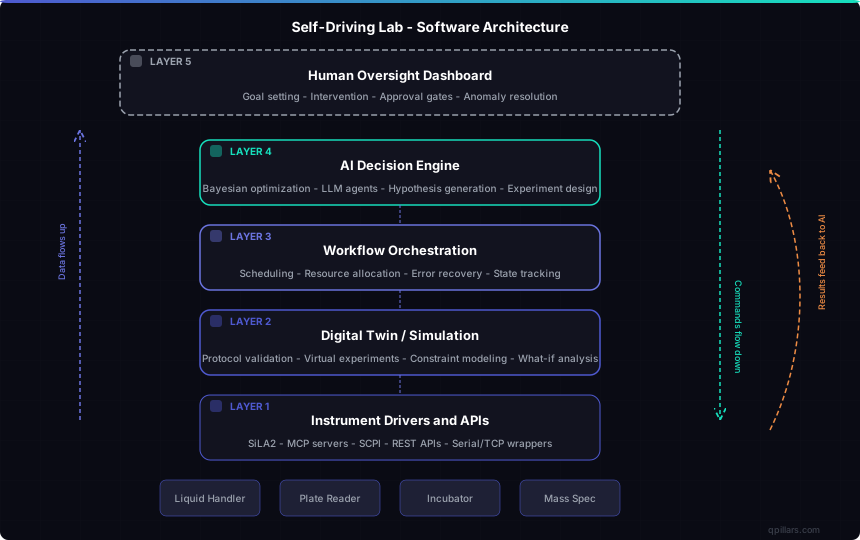
The diagram above shows what a genuine SDL requires at the software layer. Each layer is a distinct engineering challenge, and most "SDL" implementations only address one or two of them.
Layer 1 - Instrument Drivers and APIs
Every instrument in the lab needs a programmatic interface. This sounds basic, but it is the foundation that most labs lack. A typical research lab has instruments from 5-10 vendors, each with its own control software, data format, and communication protocol. Some speak SCPI over serial. Some have REST APIs. Many have only a Windows GUI with no programmatic access at all.
The SiLA2 standard was designed to solve this - a gRPC/Protocol Buffers-based communication standard for lab instruments. It is the best-established laboratory communication standard, with support from Tecan, Hamilton, and others. But adoption remains slow. Most instruments ship without SiLA2 support, and retrofitting older instruments requires custom driver development.
MCP (Model Context Protocol) addresses a complementary need - making instruments accessible to AI agents. Where SiLA2 provides structured, typed instrument control (appropriate for deterministic automation), MCP provides the discovery and natural-language interface that AI agents need. A SiLA2 instrument can be wrapped with an MCP server, giving AI agents access while preserving SiLA2 interfaces for existing LIMS and automation systems.
The practical reality: most labs building SDL capabilities today are writing custom Python wrappers around vendor APIs. This works but does not scale. The shift to SiLA2 + MCP will happen - but expect 2027-2028 for broad vendor adoption.
Layer 2 - Digital Twin and Simulation
Before an AI decision engine sends commands to physical instruments, those commands should be validated in simulation. A digital twin of the laboratory models instrument capabilities, physical constraints (volumes, temperatures, timing), and protocol logic. It catches errors that would waste expensive reagents or damage equipment.
Digital twins also enable the rapid iteration that makes SDLs valuable. An AI agent can explore thousands of virtual experiments in seconds, identifying promising parameter combinations before committing to physical execution. Without this layer, the "optimization" in an SDL is limited to sequential physical experiments - orders of magnitude slower than simulation-guided exploration.
The gap: Most SDL implementations skip simulation entirely. They run Bayesian optimization directly on physical experiments, which works for simple parameter sweeps but fails for complex multi-step protocols where errors compound. Building a digital twin requires modeling every instrument's behavior, which brings us back to the driver/API problem - you cannot simulate what you cannot programmatically describe.
Layer 3 - Workflow Orchestration
Orchestration is where individual instrument actions become coordinated protocols. This layer manages scheduling (instrument A must finish before instrument B starts), resource allocation (only one sample can be on the plate reader at a time), error recovery (if aspiration fails, retry with adjusted volume), and state tracking (which samples are where, what step they are on).
This is the layer that platforms like Automata LINQ and Chemspeed's automation address. It is also where the distinction between "automated" and "autonomous" becomes concrete. An automated orchestrator executes a predefined sequence with conditional branches. An autonomous orchestrator can replan mid-execution based on intermediate results - but only if it has real-time data from the instruments (Layer 1) and a model of what is possible (Layer 2).
Layer 4 - AI Decision Engine
The AI layer is what makes a self-driving lab "self-driving." It receives experimental results, updates its model of the problem, and decides what to run next. In practice, this ranges from Bayesian optimization (well-understood, reliable for parameter sweeps) to LLM-based agents that can reason about experimental design at a higher level.
Carnegie Mellon's Coscientist system, profiled in the Nature article, demonstrates the LLM-agent approach: GPT-4 interprets scientific problems, collects information from web searches, plans experiments, and interfaces with robotic hardware. Ginkgo's OpenAI collaboration is similar. These are genuine AI decision engines, not glorified optimization loops.
The gap: AI decision engines work well when the action space is well-defined and the objective function is clear (maximize yield, minimize impurity). They struggle with open-ended discovery where the objective itself is uncertain, where safety constraints are implicit rather than explicit, and where domain expertise is required to interpret ambiguous results. This is why human oversight remains essential - the AI optimizes within bounds that humans define.
Layer 5 - Human Oversight
Every production SDL includes a human oversight layer - and this is by design, not a limitation. In GxP environments, autonomous decisions that affect product quality require human approval under current regulations. Even in research settings, the scientist needs visibility into what the system is doing, why it made specific decisions, and the ability to intervene when something unexpected happens.
The oversight layer is also where institutional knowledge enters the system. An experienced scientist looking at an optimization trajectory might recognize that the system is converging on a local optimum, or that a particular parameter combination will cause precipitation that the digital twin does not model. This human-in-the-loop feedback is what separates SDLs that produce useful results from SDLs that produce technically optimal but practically useless outcomes.
The Regulatory Reality - GxP and Autonomous Labs
In January 2026, the FDA and EMA jointly published 10 Guiding Principles of Good AI Practice in Drug Development - the first global regulatory alignment on AI in pharmaceutical and life sciences environments. This is a landmark step, but it reinforces a fundamental constraint: you cannot delegate quality decisions to a black-box algorithm.
Key regulatory realities for SDLs in GxP environments:
- AI outputs are recommendations, not decisions. Under current regulations, a human must approve any AI-driven action that affects product quality, safety, or efficacy. This applies to batch release, manufacturing parameters, and analytical results interpretation.
- ALCOA+ applies to all data. Every data point in an SDL must be Attributable, Legible, Contemporaneous, Original, Accurate, Complete, Consistent, Enduring, and Available. This means every instrument reading, every AI decision, and every human override must be recorded in an audit trail.
- 21 CFR Part 11 governs electronic records. The digital infrastructure of an SDL - instrument data, AI decisions, orchestration logs - falls under electronic records regulations. Audit trails, access controls, and electronic signatures are mandatory.
- The FDA's CSA guidance (2025) helps. The shift from exhaustive documentation to risk-based critical thinking makes compliant AI adoption more practical. You do not need to validate every possible AI output - you need to demonstrate that the system is reliable for its intended use and that risks are controlled.
Practical implication: SDLs in regulated environments will operate at Level 3-4 for the foreseeable future, with human approval gates at critical decision points. Fully autonomous operation (Level 5) is not a regulatory impossibility - it is an engineering challenge of demonstrating sufficient reliability that regulators are comfortable removing human oversight. That demonstration does not exist yet.
Why MCP Matters for Self-Driving Labs
The Model Context Protocol is not just another integration standard. It solves a specific problem that blocks SDL development: letting AI agents discover, understand, and use laboratory instruments through a uniform interface.
Traditional instrument integration is point-to-point. You write a Python wrapper for the plate reader, another for the liquid handler, another for the incubator. Each wrapper has its own API, its own error handling, its own data format. An AI agent that orchestrates all three needs custom code for each one. Adding a new instrument means updating the agent.
MCP inverts this model. Each instrument exposes an MCP server that describes its capabilities in a standard format. An AI agent discovers available instruments through MCP, understands what they can do from standardized tool descriptions, and uses them through a uniform interface. Adding a new instrument means deploying one MCP server - every agent in the lab immediately gains access.
In December 2025, Anthropic donated MCP to the Agentic AI Foundation under the Linux Foundation, co-founded by Anthropic, Block, and OpenAI, with platinum supporters including Google, Microsoft, and AWS. The MCP Registry has over 1,000 server entries and growing. The November 2025 specification added enterprise features: OAuth 2.1 authentication, server identity verification, and streaming for real-time instrument data.
MCP and SiLA2 are complementary, not competing:
| Aspect | SiLA2 | MCP |
|---|---|---|
| Purpose | Structured instrument control | AI agent tool access |
| Transport | gRPC / Protocol Buffers | JSON-RPC over stdio/HTTP |
| Typing | Strongly typed (FDL) | Schema-based tool descriptions |
| Best for | Deterministic automation, LIMS integration | AI-driven discovery, natural language interaction |
| Maturity | Established, slow adoption | Early, rapid growth |
The optimal architecture uses both: SiLA2 for the deterministic control layer (Layer 1), MCP for the AI agent interface (Layer 4). An instrument with a SiLA2 interface gets an MCP server wrapper that exposes its SiLA2 capabilities to AI agents. Existing LIMS and automation systems continue using SiLA2 directly. New AI workflows use MCP. No migration required.
The Cautionary Tales
Not every SDL story is a success. Two examples illustrate the risks:
Strateos operated a fully automated cloud lab in Menlo Park - one of the earliest attempts at "lab-as-a-service." They pivoted from the public cloud lab model toward private, on-premises deployments - a signal that the pure remote-access model, where customers submit experiments to shared robotic infrastructure, faced commercial challenges at scale. The lesson: SDL infrastructure is valuable, but the business model matters. Labs want control over their physical infrastructure, not a black-box service.
IBM RoboRXN (IBM Research Zurich) built an impressive cloud-accessible autonomous chemistry platform with over 29,000 users and 5 million reaction predictions. It demonstrated the AI decision engine layer convincingly. But translating research demonstrations into production laboratory infrastructure remains a gap - the platform excels at reaction prediction and planning but the physical execution depends on partnerships with automation vendors (Chemspeed, Arctoris).
Where This Goes in 2026-2027
The SDL landscape will consolidate around three trends:
1. Standardization - MCP + SiLA2 as the Communication Layer
The fragmentation of instrument communication protocols is the single biggest impediment to SDL adoption. Every custom wrapper is technical debt. The convergence of MCP (for AI access) and SiLA2 (for structured control) provides a viable standardization path. Expect instrument vendors to start shipping MCP servers alongside their proprietary software by late 2027 - driven not by SDL demand specifically, but by the broader wave of AI agent adoption across all industries.
2. Consolidation - Platform Plays Win
The current SDL landscape has dozens of point solutions - a Bayesian optimizer here, an instrument driver there, a scheduling engine somewhere else. Labs that stitch these together spend more time on integration than on science. The platforms that integrate multiple SDL layers (Chemspeed/SciY, Automata LINQ, Ginkgo Cloud Lab) will absorb market share from point solutions. The winners will be platforms that are open (vendor-agnostic instrument support), layered (you can adopt incrementally), and AI-native (not AI-bolted-on).
3. The Software Layer as Competitive Advantage
Hardware commoditization is accelerating. The RoboChem-Flex platform proves that capable automation hardware can be built for $5,000. The instruments themselves are not the differentiator - the software that connects, orchestrates, and reasons about them is. Labs that invest in the software layer - instrument APIs, data pipelines, digital twins, MCP infrastructure - will be positioned to adopt SDL capabilities as platforms mature. Labs that wait for turnkey solutions will find themselves locked into whatever vendor gets there first.
The Acceleration Consortium's goal - reducing material discovery from $10M and 10 years to $1M and 1 year - is ambitious but directionally correct. The labs that get there first will not be the ones with the most robots. They will be the ones with the best software.
Frequently Asked Questions
What is a self-driving laboratory?
A self-driving laboratory (SDL) is a research facility where AI systems autonomously design experiments, robotic platforms execute them, and the AI analyzes results to decide what to run next - creating a closed Design-Build-Test-Learn loop. In practice, most SDLs today operate at Level 2-3 on a five-level autonomy scale, meaning they handle closed-loop optimization on specific tasks while humans set goals and handle exceptions. True Level 5 autonomy - where the lab operates without any human intervention - does not exist yet.
How much does it cost to build a self-driving lab?
The range is enormous. Open-source platforms like RoboChem-Flex can be built for approximately $5,000 and handle closed-loop optimization for specific chemistry applications. Enterprise SDL deployments from Chemspeed or through Ginkgo's Cloud Lab service cost millions. The Acceleration Consortium's infrastructure runs on a Can$200M grant. For most labs, the practical path is incremental: start by adding programmatic APIs to existing instruments ($10-50K per instrument), build data pipelines and a digital twin ($100-500K in engineering effort), and layer on AI decision capabilities as the infrastructure matures.
Can self-driving labs operate in GxP-regulated environments?
Yes, but with constraints. The FDA/EMA joint Guiding Principles of Good AI Practice in Drug Development (January 2026) provide a framework for AI in regulated environments. AI outputs must be treated as recommendations requiring human approval for quality-critical decisions. All data must comply with ALCOA+ principles, and electronic records fall under 21 CFR Part 11. The FDA's 2025 Computer Software Assurance guidance makes compliance more practical by shifting from exhaustive documentation to risk-based approaches. SDLs in GxP environments will likely operate at Level 3-4 with human approval gates at critical decision points.
What is the difference between MCP and SiLA2 for lab instruments?
SiLA2 is a structured communication standard for laboratory instruments using gRPC and Protocol Buffers - it defines how software controls instruments with strict typing and deterministic behavior. MCP (Model Context Protocol) is a standard for connecting AI agents to external tools - it defines how an AI system discovers and uses instruments through natural-language-friendly interfaces. They are complementary: SiLA2 handles the deterministic control layer, MCP handles AI agent access. An instrument can expose both interfaces simultaneously, with existing automation using SiLA2 and new AI workflows using MCP.
Which industries are adopting self-driving labs fastest?
Materials science and chemistry lead adoption, particularly for reaction optimization and materials screening. Drug discovery is close behind, with companies like Arctoris (Oxford) and Recursion operating automated platforms for compound screening. Synthetic biology is the most ambitious - Ginkgo Bioworks has committed to moving all R&D onto autonomous infrastructure by end of 2026. Environmental testing and clinical diagnostics are slower due to stricter regulatory requirements, but the FDA's evolving AI guidance is gradually opening the path.
Is the self-driving lab hype justified?
Partially. The underlying technology works - closed-loop optimization, robotic execution, and AI-guided experimental design deliver real productivity gains at Level 2-3. The $8.9 billion lab automation market growing to $24 billion by 2035 reflects genuine demand. What is overhyped is the timeline and the scope: marketing materials imply Level 4-5 autonomy that does not exist, and most "SDL" announcements describe platforms that handle one or two layers of the required software stack. The gap is real but closing. Labs that build the software infrastructure now will be ready when the platforms catch up.
Written by Iacob Marian, Technical Lead & Co-founder at QPillars. Published 2026-04-16.
Technical Lead & Co-founder at QPillars
Specializes in laboratory automation, from hands-on instrument control and liquid handling to AI-driven protocol orchestration.