
What Is a Digital Twin for Laboratories? A Practical Guide
What Is a Digital Twin for Laboratories? A Practical Guide
A digital twin laboratory is a live, bidirectional virtual replica of physical lab instruments, workflows, and processes - synchronized with real-time data from actual hardware. Unlike a static simulation that models what could happen, a digital twin mirrors what is happening and continuously updates in both directions. The global digital twin market reached an estimated $24.5 billion in 2025, growing at a CAGR above 35% (Fortune Business Insights, 2025), and life sciences - particularly pharmaceutical and biotech companies - represent the fastest-growing adoption segment.
This guide cuts through the marketing noise. We define what a lab digital twin actually is, how it differs from simulation, and why it matters for liquid handling, sample preparation, and AI-driven protocol development.
Digital Twin vs. Simulation - The Real Difference
The terms get used interchangeably, but they are architecturally different systems. Understanding the distinction matters for anyone evaluating lab automation investments.
A simulation runs a model on a fixed dataset to predict outcomes under hypothetical conditions. It answers "what could happen if we changed X?" The inputs are static. You run it, analyze results, and that is the end. Simulations are batch-processed, standalone tools used primarily during design or validation phases.
A digital twin maintains a persistent, bidirectional connection with the physical system it represents. It ingests real-time sensor data, updates its model continuously, and - critically - can feed optimizations back to the physical system. It answers "what is happening right now, and what will happen next?"
Three properties distinguish a digital twin from a simulation:
- Real-time data sync - The twin receives continuous data streams from physical instruments (temperatures, pressures, volumes, positions) and updates its state accordingly.
- Bidirectional coupling - Changes in the physical system update the twin, and the twin can push commands or parameter adjustments back to hardware.
- Persistent identity - A simulation can model any generic pipettor. A digital twin represents this specific Hamilton STAR on this specific bench, with its calibration history and wear characteristics.
As Rémi Lehe, Research Scientist at Lawrence Berkeley National Laboratory, noted: "A key aspect of a digital twin is the automated connection between the physical device and the simulation, eventually allowing for real-time updates in both directions" (Berkeley Lab, February 2026).
Architecture of a Laboratory Digital Twin
A lab digital twin is not a single application. It is a layered system with four distinct architectural tiers that must work together.
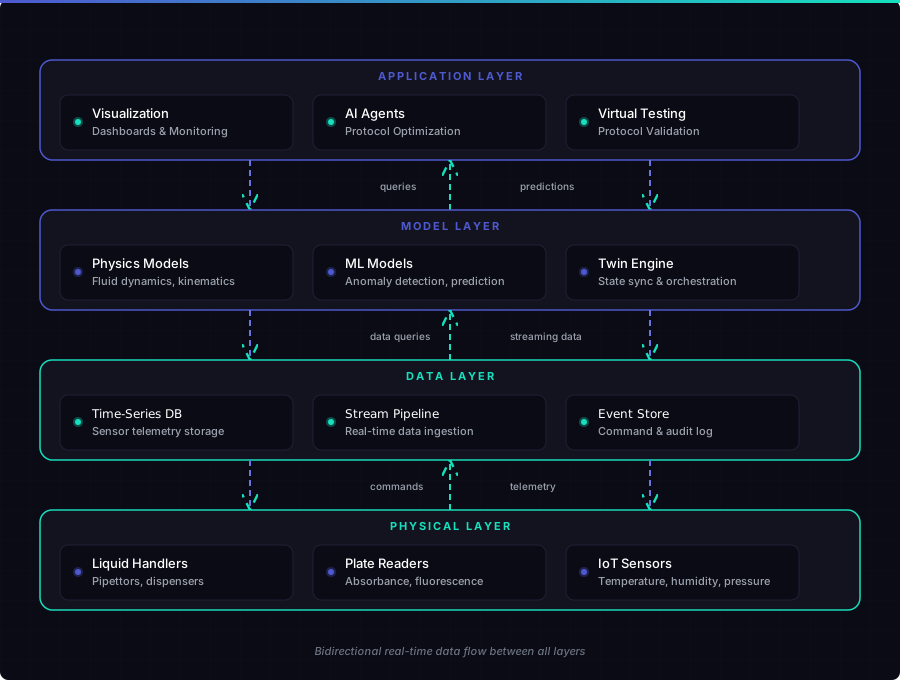
The diagram above shows how data flows through the four layers of a laboratory digital twin. Physical instruments at the bottom generate real-time telemetry that flows upward through data ingestion, into physics-based and ML models, and finally into applications that scientists and AI agents interact with. The bidirectional arrows between layers are what distinguish this from a one-way simulation pipeline.
Physical Layer
The foundation. This includes every instrument, sensor, and actuator in the lab - liquid handlers, plate readers, incubators, centrifuges, and the IoT gateways that connect them. Each device exposes telemetry (positions, temperatures, error states) and accepts commands through vendor APIs or standardized protocols like MCP.
Data Layer
Time-series databases capture every data point from the physical layer. Unlike simulation datasets that are finite and scenario-based, digital twin data stores must handle continuous, high-frequency streams. This layer handles data normalization, time alignment across instruments, and buffering for real-time processing.
Model Layer
The computational core. This layer contains two types of models working together:
- Physics-based models - Fluid dynamics for pipetting, thermal models for incubation, kinematic models for robotic arm movements. These encode the physical laws governing instrument behavior.
- Machine learning models - Trained on historical operational data to predict deviations, detect anomalies, and optimize parameters that pure physics models cannot capture (seal degradation, tip wear, environmental drift).
Application Layer
Where value is delivered. This includes visualization dashboards, AI agent interfaces, protocol optimization engines, and predictive maintenance alerts. The application layer is where scientists interact with the twin - running virtual experiments, testing protocols, and monitoring live operations.
Why Digital Twins Matter for Liquid Handling
Liquid handling is where digital twins deliver the most immediate value in laboratory automation. Here is why.
A typical liquid handling protocol involves hundreds of discrete transfers, each affected by liquid class properties (viscosity, surface tension, volatility), tip geometry, aspiration and dispense speeds, and environmental conditions. Testing a new protocol on physical hardware is slow, expensive, and risky - a single misconfigured aspiration speed can contaminate an entire plate of irreplaceable patient samples.
A digital twin of a liquid handler lets you:
- Validate protocols virtually before touching real reagents. Run the complete protocol in simulation, with the same instrument model, deck layout, and liquid classes. Catch collisions, volume errors, and timing conflicts before they waste consumables.
- Predict pipetting accuracy under varying conditions. The twin models how viscosity changes affect aspiration at different speeds, flagging transfers likely to fall outside acceptable CV thresholds.
- Optimize throughput by simulating parallel scheduling across multiple instruments without risking physical conflicts.
- Train AI agents safely. An AI agent learning to optimize a sample prep workflow can run thousands of iterations on the digital twin before executing a single transfer on real hardware.
This is exactly the approach behind QPillars LiquidBridge - our digital twin platform uses the same MCP interface for both simulated and real instruments, so AI agents can test protocols in simulation before running them on hardware.
Real-World Use Cases in Pharma and Biotech
Digital twins in life sciences are moving past pilot projects. Here are concrete applications.
Autonomous Chemistry Laboratories
MATTERIX, published in Nature Computational Science in January 2026, is a GPU-accelerated simulation framework that creates high-fidelity digital twins of chemistry laboratories. It simulates robotic manipulation, powder and liquid dynamics, device functionalities, heat transfer, and basic chemical reaction kinetics - enabling researchers to test and refine automated workflows entirely in silico before deploying them on physical hardware (Darvish et al., Nature Computational Science, 2026).
Accelerated Scientific Discovery
Berkeley Lab's Digital Twin for Chemical Sciences (DTCS) platform compressed discovery timelines "from months to minutes" by enabling researchers to observe chemical reactions, adjust experimental parameters, and validate hypotheses simultaneously during a single experiment (Berkeley Lab, February 2026).
Biomanufacturing Optimization
Pharmaceutical companies are deploying process digital twins to simulate and optimize cell culture, fermentation, and purification workflows. The twin enables real-time decision-making during production runs - adjusting feed rates, temperature profiles, and pH setpoints based on live sensor data rather than waiting for offline analytics. According to Precedence Research, bioprocessing and manufacturing optimization was the largest application segment for digital twins in life sciences in 2025 (Precedence Research, 2025).
Multi-Vendor Lab Integration
At SLAS 2026, ABB demonstrated robotic systems working across Mettler Toledo and Agilent ecosystems - autonomous pipetting, decanting, vial handling, filtration, and GC loading across instruments from different vendors (ABB/Automate.org, 2026). Digital twins make this multi-vendor orchestration possible by providing a unified virtual representation of the entire workflow, regardless of which vendor built each instrument.
How Digital Twins Enable Safe AI-Driven Protocol Testing
This is where digital twins become transformative rather than incremental. The convergence of digital twins and AI agents creates a fundamentally new capability: safe, autonomous protocol development.
The traditional workflow for developing a new sample preparation protocol looks like this: a scientist writes the protocol, runs it on hardware, observes failures, adjusts parameters, and repeats. Each iteration takes hours or days and consumes reagents.
With a digital twin, an AI agent can:
- Generate candidate protocols based on the desired outcome (target volumes, concentrations, throughput).
- Execute each candidate on the digital twin - hundreds or thousands of variations in minutes, not weeks.
- Evaluate results against quality metrics (CV, recovery, throughput, cost per sample).
- Rank and optimize the top candidates using reinforcement learning.
- Present the best protocol to the scientist for review and single-run physical validation.
The critical requirement is interface parity - the digital twin must expose the exact same API as the physical instrument. When the AI agent switches from twin to hardware, the only change is the connection endpoint. This is why protocol-level standards like MCP matter - they provide a uniform interface layer that makes the twin and the physical instrument interchangeable from the agent's perspective.
interface InstrumentConnection {
  type: "digital_twin" | "physical";
  endpoint: string;
  instrumentModel: string;
  deckLayout: DeckConfiguration;
}

// The agent code is identical regardless of target
async function executeProtocol(
  connection: InstrumentConnection,
  protocol: Protocol
): Promise<ExecutionResult> {
  const client = new MCPClient(connection.endpoint);

  for (const step of protocol.steps) {
    const result = await client.callTool(step.tool, step.parameters);
    if (!result.success) {
      return { status: "failed", failedStep: step, error: result.error };
    }
  }

  return { status: "completed", metrics: await client.getRunMetrics() };
}
The code above shows how interface parity works in practice. The executeProtocol function does not know or care whether it is talking to a digital twin or a physical instrument - the MCP interface is identical. This is not theoretical architecture; it is how QPillars builds AI agent workflows for laboratory automation.
Market Adoption and What Comes Next
Despite the clear value proposition, digital twin adoption in laboratories remains early-stage. A 2025 review in ScienceDirect noted that "implementation of digital twins in pharmaceutical and biopharmaceutical sectors remains in its initial stages" - citing data integration complexity, regulatory compliance requirements, and biological system variability as primary barriers (ScienceDirect, 2025).
The market is moving quickly regardless. Key trends for 2026 and beyond:
- AI-native architectures - New digital twin platforms are being built with AI agent integration as a first-class capability, not bolted on afterward. The twin is the training environment, the validation sandbox, and the monitoring dashboard for AI-driven workflows.
- Protocol-level interoperability - Standards like MCP are enabling digital twins that work across vendor boundaries. A single twin can represent a Hamilton liquid handler, an Agilent plate reader, and a custom incubator in a unified virtual environment.
- Regulatory recognition - As digital twins demonstrate their value for process validation and quality assurance, regulatory frameworks (FDA, EMA) are beginning to consider virtual validation evidence alongside physical testing data.
- Cloud-native deployment - Moving twin infrastructure to the cloud enables collaboration across sites and makes high-fidelity simulation accessible to labs that cannot afford on-premise GPU clusters.
The labs that adopt digital twins now are not just automating existing workflows - they are building the infrastructure for a fundamentally different way of doing science, where AI agents develop and optimize protocols in virtual environments before a single pipette tip touches a real sample.
Frequently Asked Questions
What is the difference between a digital twin and a LIMS?
A LIMS (Laboratory Information Management System) manages samples, data, and workflows at the information level. A digital twin replicates the physical behavior of instruments and processes in real time. They are complementary - a LIMS tracks what happened, while a digital twin models how and why it happened, and predicts what will happen next.
How much does it cost to build a digital twin for a laboratory?
Costs vary widely depending on scope. A digital twin of a single liquid handler can be built with existing physics engines and vendor APIs for a modest investment. A full-lab twin covering dozens of instruments requires significant data infrastructure. The key cost driver is not software - it is the sensor instrumentation and data pipeline engineering needed to feed the twin with real-time data.
Can digital twins replace physical validation in regulated environments?
Not yet, and likely not entirely. Regulatory bodies like the FDA and EMA are increasingly open to digital evidence as supplementary validation, but physical testing remains required for GxP-critical processes. Digital twins reduce the number of physical validation runs needed by identifying optimal parameters virtually - cutting validation timelines and consumable costs.
What data infrastructure does a laboratory digital twin require?
At minimum: time-series data collection from instrument sensors (typically via MQTT or REST APIs), a streaming data pipeline for real-time ingestion, and sufficient compute for physics-based simulation. Cloud platforms reduce the infrastructure burden, but latency requirements may favor edge computing for real-time control loops.
How do digital twins handle instruments from different vendors?
This is the core interoperability challenge. Protocol-level standards like MCP provide a uniform interface layer that abstracts vendor-specific APIs. The digital twin communicates through this standard interface, making it possible to represent a multi-vendor lab as a single coherent virtual environment rather than isolated instrument silos.
Key Takeaways
- A digital twin laboratory is a live, bidirectional virtual replica of physical instruments and workflows - not a static simulation. The distinction matters for architecture and investment decisions.
- The global digital twin market exceeded $24 billion in 2025 with a CAGR above 35%, and life sciences is the fastest-growing adoption segment (Fortune Business Insights).
- Liquid handling and sample preparation are the highest-value use cases for lab digital twins, enabling virtual protocol validation that saves reagents, time, and risk.
- AI agents combined with digital twins create a new paradigm - autonomous protocol development where thousands of variations are tested virtually before a single physical run.
- Interface parity between twin and hardware (via standards like MCP) is the architectural requirement that makes safe AI-driven protocol testing possible.
Written by Iacob Marian, Technical Lead & Co-founder at QPillars. Published 2026-03-26.
Technical Lead & Co-founder at QPillars
Specializes in laboratory automation, from hands-on instrument control and liquid handling to AI-driven protocol orchestration.