
Can an AI Assistant Troubleshoot a Lab Instrument? A Local LLM Architecture
A lab instrument stops halfway through a run. The operator sees a short error message. The explanation may be spread across an operating manual, a software release note and a log file. Before anyone can decide what to do, someone has to connect those facts.
That is a useful job for an AI assistant for laboratory instruments: explain the reported problem, collect the relevant evidence and help a person choose the next check. A small local language model can be a reasonable candidate when the task is well defined and the information is retrievable. The architecture has to make that information available and keep the model's conclusions within what it supports.
Start with a stopped run and a clear job
“Why did this run stop, what should I check next, and what should I send to support?”
For the operator, the useful result is an explanation tied to this run, an applicable next check and a clear handoff if specialist help is needed. For an instrument manufacturer, the first product can cover one recurring support problem on one instrument family.
Consider a liquid handler reporting an incomplete transfer. An explicit rejection before execution and a communication timeout after dispatch call for different investigations. A record may establish that a software check prevented execution. After a timeout, the assistant needs further evidence. It should not turn “no response received” into “nothing moved.”
The assistant can explain that distinction, retrieve the approved investigation procedure and assemble the records for support. Authorizing another transfer is a separate capability. Our guide to AI assistants and agents for lab instruments explains how to choose that product boundary.
Why a local LLM can be enough for useful support
Explaining a documented error, asking for a missing software revision and drafting a factual support summary do not inherently require a frontier model. They require the right information and a model that can reliably perform those particular tasks.
Give each component a clear responsibility. Retrieval finds applicable knowledge. Read-only tools supply observations. Application logic resolves identifiers, checks permissions and records execution outcomes. The language model turns that context into an explanation or a focused follow-up question.
Local inference is worth evaluating when documentation and run records should stay on site, or support must work without an external inference service. “Local” can mean an instrument PC, a lab server or an OEM-managed installation. Model size and deployment location are separate choices; select both against the hardware and task requirements.
The 2026 EffGen research explores task decomposition, context preparation and routing for small-model agents. It supports evaluating workflows designed around a model's capabilities; it does not establish accuracy on laboratory instruments.
Start with the smallest model that passes your support cases at an acceptable response time. Difficult cases can go to a specialist or an explicitly permitted stronger model. Include embedding inference, document processing and telemetry in the deployment decision: a local LLM alone does not establish where the rest of the data goes.
The architecture: knowledge, observations and a bounded assistant
Approved manuals, release notes, permitted code and instrument observations form a shared foundation. Different assistants can use it with their own task instructions, access rights and acceptance criteria.
For the stopped-run assistant, the pipeline is straightforward:
- Identify the case. Establish the instrument, software revision, run and symptom. Ask for missing identifiers before choosing release-specific guidance.
- Retrieve applicable knowledge. Find the explanation and approved investigation procedure, preserving source references and warnings.
- Read available evidence. Collect permitted logs, configuration and timestamped status for that case.
- Compose and check the response. Explain the evidence, identify uncertainty and suggest a supported next check or prepare a service handoff.
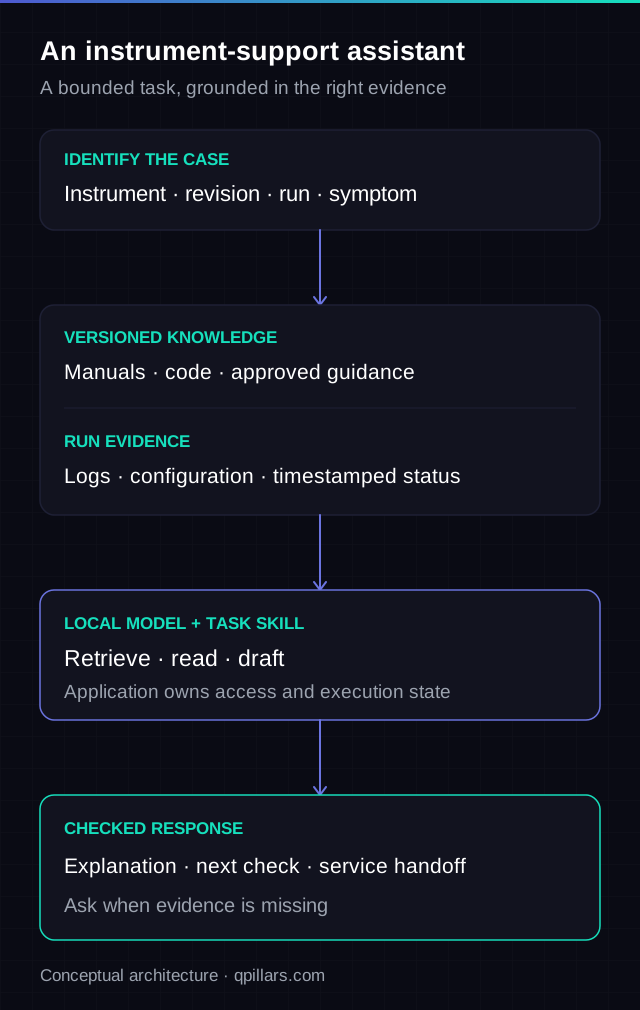
A graph-based workflow can manage retrieval, tool calls and clarification. LangGraph is one implementation option; the important decisions are the context supplied at each step and the conditions for answering or escalating.
Make manuals and code retrievable
Retrieval-augmented generation, or RAG, places relevant source material in the model's working context. Instrument support needs more structure than a folder of extracted PDF text.
Preserve headings, page references and warnings. Check tables and diagrams after extraction: a procedure can lose its meaning when a warning is separated from its step. Each passage needs an instrument family, applicable revisions, document authority and access rules.
When source code is available and permitted, index meaningful units such as functions and classes with their symbols and surrounding context. Syntax-aware extraction can preserve those boundaries. Code explains software behavior; it does not independently establish physical instrument state. Refresh the index when approved documents or code change, and retain the version behind each answer.
Embeddings help retrieve related meaning. A run that “froze after sending a command” may match guidance about an “unconfirmed execution outcome.” Exact search remains useful for error codes, command names and part identifiers. Hybrid retrieval combines those signals; version and permission filters decide what may be returned. Contextual retrieval research explains why retaining context around passages matters.
Give the assistant a focused skill
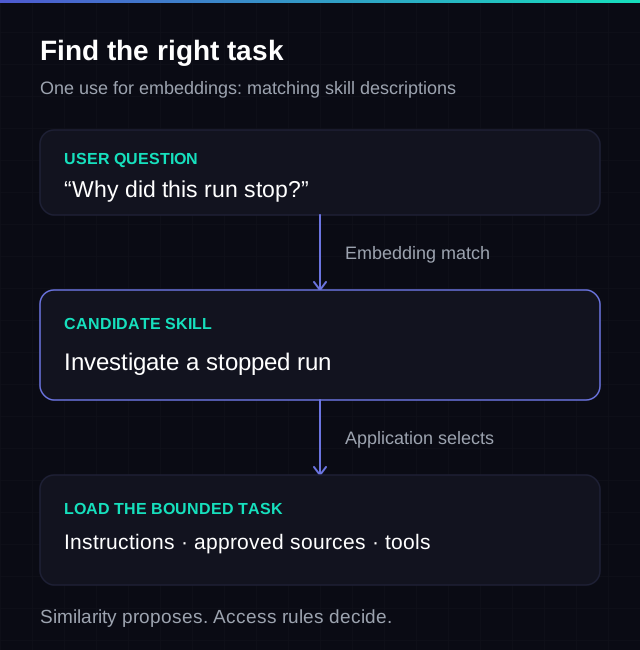
A skill describes when a task applies, which evidence to request, which tools are allowed and what a satisfactory answer contains. An “investigate a stopped run” skill might require the run identifier, applicable guidance and execution records before drafting an explanation.
Embedding search can propose that skill from the user's wording. The application then loads its instructions and permitted tools. Similarity helps find a candidate; it does not grant access or establish applicability. With only a few tasks, an explicit selector can be simpler than semantic routing.
Use existing logs, and understand what they prove
You do not need to replace an instrument's logging system to start. Existing text logs, exported run records or an approved status API can supply context. A thin normalization layer can preserve the original event alongside its time, source, run identifier, command and reported outcome.
Can you connect an error to the correct run, distinguish a rejected request from an unknown outcome and establish the age of a status observation? Missing evidence becomes a specific integration requirement. OpenTelemetry can correlate participating software components, but cannot reconstruct an instrument event that was never recorded.
Expose narrow read-only capabilities, such as retrieving a run's events or looking up a documented error. The Model Context Protocol for lab instruments can provide a common interface. Permissions and command authority remain application responsibilities. Retrieved documents and logs are evidence, not instructions allowed to change those responsibilities.
What our implementation taught us about small models
In our reference implementation, a CPU-local Granite 4.2 3B model and hosted Claude Opus 5.5 both answered six source-based lookup questions successfully. The local model also made an unsupported claim on one of two questions whose answer was absent. On a separate, broader set of eight support tasks, it completed 3/8 and the hosted model 7/8.
One incorrect explanation carried a real quotation. The engineering lesson: check whether a source supports the claim, alongside source identity and output format. A valid citation can accompany a wrong conclusion.
The captured results, examples and method include failures and the direct-excerpt baseline. The corpus contained authored guidance, public code and synthetic records, with no physical instrument connected. The narrower task also changed retrieval and answer requirements. These results support task-specific evaluation; they do not demonstrate hardware troubleshooting accuracy or time savings.
A useful first product for an instrument manufacturer
There are visible industry signals for instrument-support assistants. Tecan Introspect describes agentic recommendations from instrument data and currently invites early access. Waters' 2024 Sustainability Report describes an internal Service Assistant for expert centers and field-service engineers. These are distinct vendor initiatives, not evidence that either uses local models.
A practical first delivery is one instrument family, one recurring fault category and a read-only assistant in the existing support path. Agree on the authoritative knowledge, available observations and escalation conditions. Then evaluate:
- Usefulness: Can operators and support engineers reach the next appropriate check more easily than with document search alone?
- Grounding: Does each explanation follow from the applicable sources and this run's evidence?
- Uncertainty: Does the assistant request missing information and distinguish known results from unknown outcomes?
- Operation: Does the local deployment meet response-time, access and maintenance requirements?
That gives the model a useful, testable job: help someone understand the instrument's reported behavior and move the investigation forward.
QPillars develops custom AI assistants for laboratory instruments, connecting instrument software with retrievable knowledge and bounded workflows. Bring a recurring support problem to discuss a focused implementation. For engineering teams building this capability, the Agentic Lab Academy team workshop offers a practical starting point.
Technical Lead & Co-founder at QPillars
Specializes in laboratory automation, from hands-on instrument control and liquid handling to AI-driven protocol orchestration.