
AI Predictive Maintenance for Lab Instruments: From Reactive Alerts to Proactive Agents
AI Predictive Maintenance for Lab Instruments: From Reactive Alerts to Proactive Agents
AI predictive maintenance for lab instruments uses live telemetry - pump pressure, lamp hours, detector drift, vacuum, temperature, error-code frequency - to forecast failures before they stop a run, then acts on that forecast automatically. The economic case is already proven: studies from McKinsey and the US Department of Energy show predictive programs cut unplanned downtime by 30-50% and extend equipment life by 20-30%, while a single day of diagnostic-lab downtime can cost $50,000 or more (IntuitionLabs, 2026). The gap in 2026 is not sensing - every major vendor already streams instrument data to the cloud - it is the layer that turns that data into a decision and a decision into an action. That is where AI agents change the model.
Key Takeaways
- Monitoring is solved; action is not. Thermo Fisher, Agilent, Bruker, Waters, and Tecan all stream instrument telemetry to the cloud. Almost all of it stops at a dashboard or an email alert that a human still has to triage.
- The downtime math is unforgiving. Unplanned instrument failure costs roughly 35% more per repair than scheduled work, and a day of lost throughput on a high-value analyzer runs $40,000-$50,000 (IntuitionLabs, 2026).
- Predictive maintenance is a four-stage maturity curve - reactive, preventive, predictive, prescriptive/agentic - and most labs sit between stages one and two.
- AI agents add the missing stage: they correlate signals across instruments, diagnose probable cause, and take a bounded action - opening a work order, alerting an operator, or pausing a run before a sample is lost.
- The agent layer is an integration problem, not a model problem. It needs structured, normalized instrument data and a safe action interface - which is exactly what an MCP-native control plane provides.
- AI predictive maintenance for lab instruments only delivers ROI when the agent can close the loop - read telemetry, decide, and act - inside the constraints of a GxP environment.
What reactive maintenance actually costs
Most labs still run a hybrid of reactive and calendar-based maintenance: fix it when it breaks, and service everything else on a fixed annual schedule whether it needs it or not. Both are expensive in opposite directions.
Reactive failure is the costly tail. Unplanned downtime triggers emergency call-outs, expedited parts shipping, and overtime - which is why the same repair costs roughly 35% more per minute when it is unplanned versus scheduled (IntuitionLabs, 2026). For high-throughput labs the throughput loss dwarfs the repair bill: a diagnostic lab running 1,000 samples a day at $50 each loses around $50,000 for every day an analyzer is down, and a 48-hour outage costs roughly $100,000. Deloitte estimates unplanned downtime costs industrial operators about $50 billion per year (Deloitte Insights).
Calendar-based preventive maintenance fixes the surprise problem but introduces waste in the other direction - you service parts that have plenty of life left and still miss failures that do not follow the calendar. Predictive maintenance targets the middle: act on the actual condition of the instrument. The published returns are consistent across sectors - 30-50% less unplanned downtime, 10-40% lower maintenance cost, and 20-30% longer equipment life (McKinsey, via WorkTrek; US DOE data via IntuitionLabs). The laboratory predictive-maintenance market reflects the pull: an estimated $1.42B in 2024 growing toward $6.92B by 2033.
What the major instrument vendors already do
The connected-instrument layer is mature. Every major analytical vendor now ships a cloud platform that collects telemetry and surfaces it remotely. The table below summarizes what each platform monitors and how far up the maturity curve it reaches.
| Vendor | Platform | What it monitors | Maturity |
|---|---|---|---|
| Thermo Fisher | InstrumentConnect / Connect Edge | 24/7 status, sensor telemetry, alarms across 700+ device models via OPC-UA | Monitoring + alerts |
| Agilent | CrossLab Smart Alerts | Usage-based maintenance timing, predictive alerts for critical-component failure on GC/LC/MS | Predictive (component-level) |
| Waters | waters_connect System Monitoring + Data Intelligence | Run/idle/error state, method, column and instrument performance; early-warning on drift | Predictive + proactive alerts |
| Bruker | LabScape / TwinScape | NMR magnet health, LC-MS digital twin of key run parameters; remote diagnostics | Monitoring + digital twin |
| Tecan | Introspect | Uptime, consumables usage, error rates, utilization and an efficiency score for liquid-handling fleets | Monitoring + insights |
Two things stand out. First, the parameters are converging on the same physical signals - the things that actually predict failure (more on those below). Second, the vendors are explicitly reaching for the next layer. Agilent's Smart Alerts already issues predictive alerts for component failure rather than fixed-interval reminders. Waters markets early-warning on "unusual behavior or performance drops" to cut mean-time-to-repair. Tecan describes the latest Introspect as built for "agentic AI readiness and advanced data science" - vendor language that concedes the dashboard is not the destination.
But across the board, the loop still closes on a human. The platform raises a flag; an operator or service engineer reads it, interprets it, and decides what to do. At fleet scale, that triage queue is the new bottleneck.
The maturity curve: reactive to proactive
It helps to see predictive maintenance as a progression rather than a binary. Each stage adds one capability the previous one lacked, and the role of the human shrinks as the role of data grows.
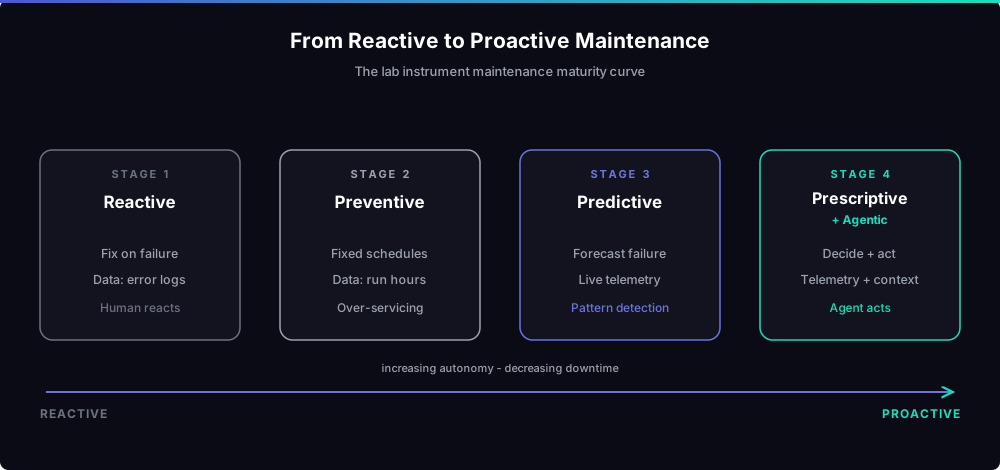
The diagram traces the four stages. Reactive maintenance acts only after failure, using error logs as after-the-fact evidence - the human reacts. Preventive maintenance acts on fixed schedules using run hours, which trades surprise for over- and under-servicing. Predictive maintenance is the first stage to use live telemetry to forecast failure, detecting patterns before they become faults - this is where the best vendor platforms operate today. Prescriptive / agentic maintenance adds the final step: an AI agent does not just predict, it decides and acts within defined bounds. The leftward stages are reactive postures; the rightward stages are proactive. The jump that matters - and the one no dashboard makes on its own - is from "predicted" to "acted on."
How AI agents close the loop
A predictive model produces a number: a risk score, a remaining-useful-life estimate, an anomaly flag. On its own, that number lands in a queue. An AI agent is the component that consumes the number, reasons about it in context, and takes a bounded action.
The architecture below shows how telemetry becomes action in an MCP-native system - the same pattern we describe in connecting AI agents to lab instruments with MCP.
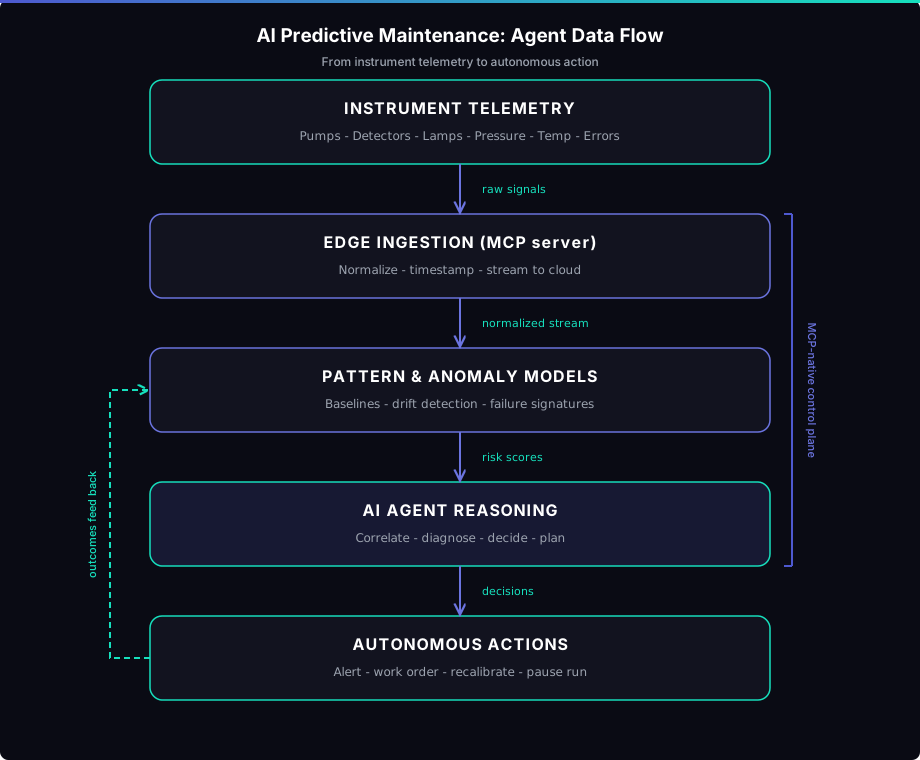
Reading the architecture top to bottom: raw signals leave the instrument (pumps, detectors, lamps, pressure, temperature, error codes). An edge ingestion layer - in practice, an MCP server wrapping the vendor SDK - normalizes and timestamps them and streams them to the cloud. Pattern and anomaly models maintain a baseline for each instrument and flag drift and known failure signatures. The AI agent is the reasoning layer: it correlates signals across instruments, diagnoses a probable cause, and decides on a plan. Finally, the autonomous actions layer executes within guardrails - raise an alert, open a work order, trigger a recalibration, or pause a run before a sample is lost. The feedback loop sends real outcomes back to the models so the baselines sharpen over time.
What makes this work is not a smarter model - it is structured access to the instrument. The agent needs two interfaces: a clean way to read normalized telemetry, and a safe, permissioned way to act. That is precisely what an MCP server provides, and why we argue the bottleneck in lab AI is the software middleware, not the algorithms.
A predictive-maintenance tool exposed to an agent looks like this in practice:
// MCP tool the agent calls to assess a single instrument's failure risk.
// Returns a structured verdict the agent reasons over - never a raw dump.
import { z } from "zod";

const InstrumentHealth = z.object({
  instrumentId: z.string(),
  pumpPressureBar: z.number(),       // trending up = seal wear
  lampHours: z.number(),             // approaching rated life
  detectorDriftPct: z.number(),      // baseline signal drift
  errorRate24h: z.number(),          // soft errors per 24h
  riskScore: z.number().min(0).max(1),
  predictedFailureWindowDays: z.number().nullable(),
});

type Verdict = z.infer<typeof InstrumentHealth>;

// The agent decides; the action layer enforces what it is allowed to do.
function decideAction(v: Verdict): "monitor" | "alert" | "work_order" | "pause_run" {
  if (v.riskScore < 0.3) return "monitor";
  if (v.predictedFailureWindowDays !== null && v.predictedFailureWindowDays <= 2) {
    return v.errorRate24h > 5 ? "pause_run" : "work_order";
  }
  return "alert";
}
The point of the structured contract is governance. The agent reasons in natural language over the verdict, but every action it can take is enumerated and permissioned. In a regulated lab, "pause a run" is a far higher-trust action than "send an alert," and the action layer - not the model - is where that boundary is enforced. This is the same agentic shift we cover in moving lab workflows from scripts to autonomous systems.
Which parameters actually predict failure
Predictive maintenance is only as good as the signals it watches. Across instrument classes, the same physical parameters carry early warning:
- Fluidics: pump pressure trending upward (seal and check-valve wear), flow instability, leak detection on LC and liquid-handling systems.
- Optics and detectors: lamp hours against rated life, baseline signal drift, and signal-to-noise degradation that precedes a failed calibration.
- Vacuum and source health: chamber pressure and source contamination on mass spectrometers.
- Thermal: temperature stability and thermal-cycle counts on incubators, ovens, and PCR blocks.
- Mechanical: vibration and motor-current signatures on robotic arms and autosamplers.
- Behavioral: error-code frequency and soft-error clustering - often the earliest cross-instrument signal that something is degrading.
The art is correlation. A single lamp-hours reading is a calendar reminder. Lamp hours rising together with detector drift and a cluster of soft errors is a failure signature - and correlating those across signals and across an instrument fleet is exactly the kind of judgment an agent does well and a static threshold does not. A digital twin of the instrument sharpens this further by letting the agent compare live behavior against an expected-performance model.
What this looks like in production
We have built the foundation of this stack with real instrument makers. For Ridgeview Instruments, makers of the LigandTracer real-time binding analyzer, we delivered a cloud-connected remote monitoring platform - real-time experiment visualization, secure remote access, and intelligent alerts so researchers can track long-running live-cell assays from outside the lab and catch experimental errors before they waste an irreplaceable sample.
That engagement is the monitoring-and-alerting foundation - stages two and three of the maturity curve - built on the kind of normalized, cloud-streamed instrument data an agent layer needs. The architecture above is the natural next step: the same telemetry pipeline, with an agent on top that does not just notify a scientist but decides and acts. That progression, from connected instrument to agentic uptime, is the core of our AI-for-instruments work.
Doing this safely in a regulated lab
Autonomous action in a GxP or accredited environment is constrained, and that is appropriate. Three rules keep AI predictive maintenance for lab instruments deployable rather than risky:
- Bounded action sets. The agent chooses from an enumerated, permissioned list. High-trust actions (pausing a run, recalibrating) require tighter approval than low-trust ones (alerting a human).
- Full audit trail. Every signal the agent saw, every inference it made, and every action it took is logged - the same traceability a regulated lab already expects from its instruments.
- Human-in-the-loop where it counts. Prediction and triage can be fully autonomous; the irreversible physical actions keep a human approval step until the model has earned trust on that instrument class.
Done this way, the agent removes the triage queue without removing accountability - which is the whole point of moving from reactive to proactive.
Frequently Asked Questions
What is AI predictive maintenance for lab instruments?
It is the use of machine learning and AI agents to forecast instrument failures from live telemetry - pump pressure, lamp hours, detector drift, error rates - and then act on the forecast before a failure interrupts a run. Unlike calendar-based preventive maintenance, it responds to the actual condition of the instrument, and unlike a monitoring dashboard, an agent can close the loop by taking a bounded action.
How is predictive maintenance different from the remote monitoring my vendor already offers?
Vendor platforms like Thermo Fisher InstrumentConnect, Agilent CrossLab Smart Alerts, Waters waters_connect, and Tecan Introspect are excellent at collecting telemetry and raising alerts. The difference is the action layer: most platforms stop at a notification a human must triage. AI agents add reasoning and bounded action on top of that same data - correlating signals, diagnosing cause, and opening a work order or pausing a run automatically.
What does instrument downtime actually cost?
Published figures put unplanned downtime on a high-value analyzer at roughly $40,000-$50,000 per day of lost throughput, and an unplanned repair costs about 35% more than the same work scheduled in advance. Across industry, Deloitte estimates unplanned downtime at around $50 billion per year. Predictive programs typically cut unplanned downtime by 30-50%.
Which instrument parameters best predict failure?
The strongest early-warning signals are pump pressure (seal and valve wear), lamp hours against rated life, detector or baseline signal drift, vacuum and source health on mass spectrometers, thermal stability, vibration on moving parts, and clustering of soft error codes. Correlating several of these together is far more predictive than any single threshold.
Is autonomous predictive maintenance safe in a regulated lab?
Yes, when it is bounded. The agent acts from an enumerated, permissioned set of actions, logs a full audit trail, and keeps a human approval step for irreversible physical actions until it has earned trust on that instrument class. Prediction and triage can be fully autonomous; high-trust actions stay gated.
Key Takeaways
- AI predictive maintenance for lab instruments moves a lab from reactive repair to proactive, agent-driven uptime - the value is in acting on predictions, not just generating them.
- Connected-instrument platforms from every major vendor already stream the right telemetry; the unsolved layer is the agent that decides and acts on it.
- The economics are settled - 30-50% less unplanned downtime, 20-30% longer equipment life, and $40,000-$50,000 saved per avoided day of analyzer downtime.
- The hard part is integration, not modeling: an agent needs normalized telemetry to read and a safe, permissioned interface to act - an MCP-native control plane.
- Safe deployment in a GxP lab comes from bounded action sets, full audit trails, and human approval on irreversible actions - autonomy where it is cheap, oversight where it is not.
Written by Iacob Marian, Technical Lead and Co-founder at QPillars. Published 2026-05-29.
Technical Lead & Co-founder at QPillars
Specializes in laboratory automation, from hands-on instrument control and liquid handling to AI-driven protocol orchestration.